
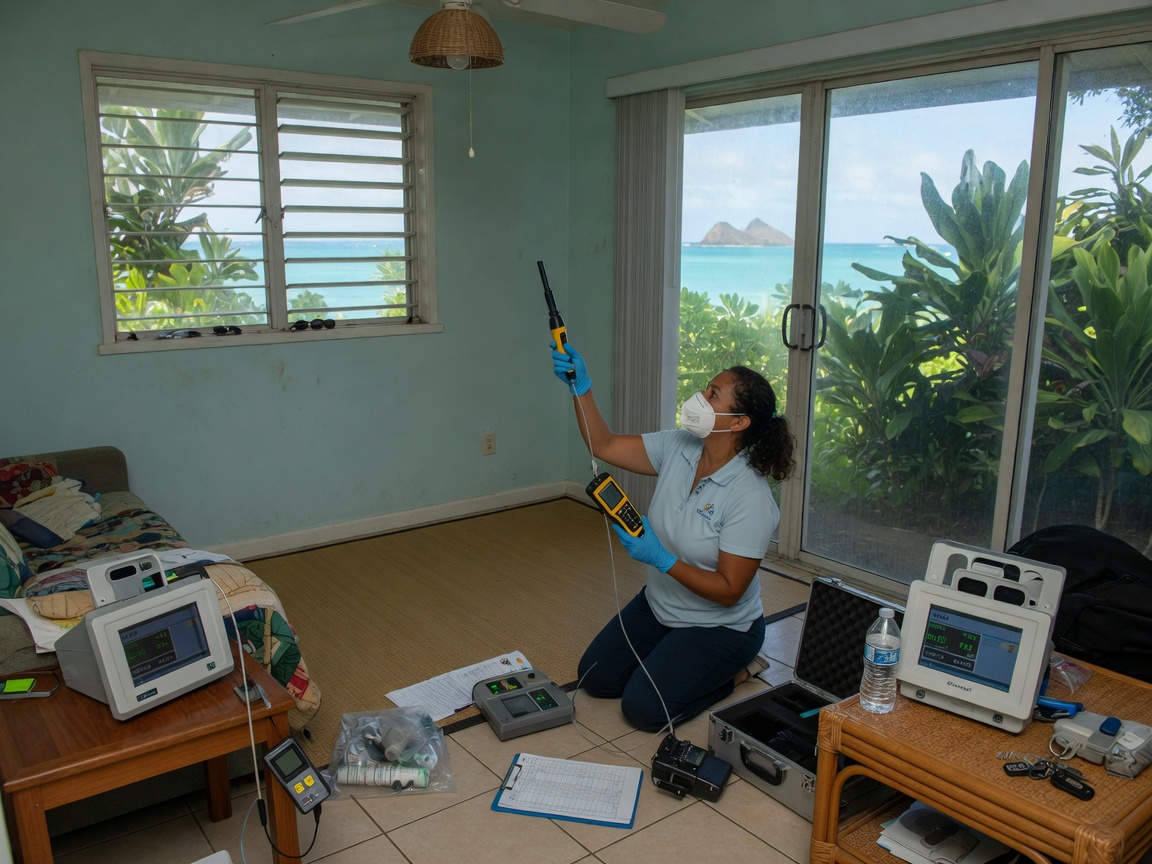
Kailua's older single-family homes near Kailua Beach Park and Lanikai Beach often sit on coral-based soil that holds moisture, allowing mold colonies to form inside wall cavities and ductwork when trade winds push humid air through unsealed joints. Testing here requires sampling supply and return plenums plus multiple rooms because constant airflow can spread spores from a single bathroom to living areas before occupants notice musty odors. Technicians also check for salt-air corrosion on evaporator coils, which reduces dehumidification capacity and lets excess moisture raise indoor relative humidity above 60 percent even with the AC running.
In neighborhoods bordering Kaneohe Bay, many 1970s and 1980s homes have single-pane windows and minimal attic insulation, so morning trade winds carry pollen and ocean mist indoors that settles on coils and filters. Standard particle counts miss the combination of biological growth and volatile compounds from stored surf equipment or cleaning products common in these households. Proper testing uses calibrated meters at breathing height plus surface swabs from condensate pans, because failing to locate the moisture source leaves the AC system re-contaminating the space after any filter change.
Honolulu County building practices in Kailua frequently include slab-on-grade construction with limited crawl-space ventilation, trapping ground moisture that feeds hidden mold under flooring. When residents request testing after noticing allergy spikes during the wetter winter months, the protocol includes checking return-air pathways that pull air from laundry rooms or garages where chemicals are stored. Documenting these conditions helps homeowners understand why simply replacing the AC filter never resolves recurring respiratory irritation in this climate.
Technician insight
In Kailua the thing that catches most people out with Indoor Air Quality Testing is how trade winds keep pushing humid salt air through every small gap around windows and doors, so the mold we find is almost always on the windward side of the house near the AC return. Older slab homes here trap that moisture under the floor, and testing only the air never shows the real source until we pull baseboards.
Recurring Musty Odor in Lanikai Home
A homeowner in Lanikai noticed allergy symptoms that worsened on windy days. Testing revealed elevated mold spores entering through the return duct near the laundry room where ocean mist had been accumulating. We sealed the duct joints, recommended a dehumidifier tied to the existing AC, and confirmed levels dropped on the follow-up visit.
Indoor Air Quality Testing Services We Offer
✓Mold Spore Sampling
Air and surface sampling for mold in homes where trade-wind moisture keeps indoor humidity elevated year-round.
✓Allergen and Pollen Testing
Measurement of outdoor pollen and dust-mite levels that trade winds carry into unsealed Kailua and Lanikai residences.
✓VOC Detection
Screening for volatile organic compounds from stored beach gear and household products common in Kaneohe Bay area homes.
✓Humidity and Condensation Assessment
Evaluation of moisture sources around AC coils and condensate lines that fail to keep pace with constant tropical humidity.
✓Ductwork Contaminant Testing
Inspection of supply and return ducts for accumulated dust, mold, and salt residue in older Kailua housing stock.
Indoor Air Quality Testing Cost in Kailua, HI
| Service | Typical Range | What Affects It |
|---|---|---|
| Basic IAQ Assessment | $225–$325 | Three air samples plus humidity reading in single-story Kailua homes. |
| Mold-Focused Testing | $275–$450 | Air and surface samples from moisture-prone rooms near Lanikai or Kaneohe Bay. |
| Full Home Panel | $400–$650 | Five zones, VOC screen, and duct inspection in two-story properties. |
| Follow-Up Verification | $150–$250 | Post-remediation sampling after identified issues are addressed. |
Ranges are typical for Kailua, HI and confirmed with an exact written quote before any work starts.
How it works
- 1
Initial Walk-Through
Technician inspects the home layout, AC system location, and visible moisture signs while noting proximity to beaches or bay.
- 2
Air And Surface Sampling
Multiple samples collected from living areas, bedrooms, and duct registers using calibrated pumps and swabs.
- 3
Lab Analysis
Samples sent for identification of mold types, allergen counts, and VOC levels specific to coastal environments.
- 4
Findings Review
Detailed report delivered with recommendations tied to the home's age, construction, and trade-wind exposure.
Pricing
Cost depends on number of samples, home size, and whether lab rush service is needed.